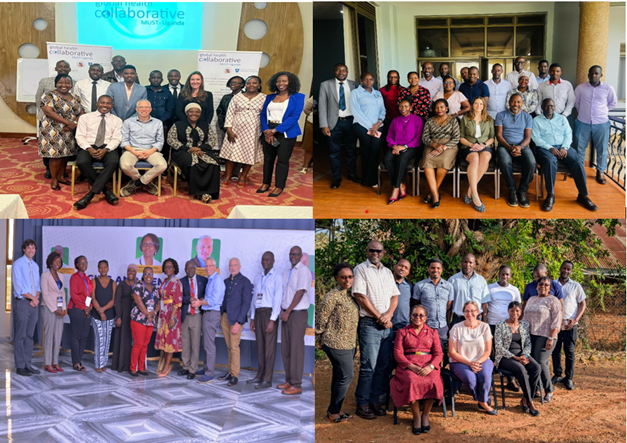
Study title: Clinical Spectrum and Societal Impact of Cognitive Impairment, Alzheimer’s and Related Dementias Among People with HIV in Uganda
Purpose: This study aims to learn about memory and thinking problems among older aged people in Uganda. To do so, we plan to study approximately 600 people in Uganda (300 people with HIV (PWH) and 300 HIV-negative) and follow them for 4-5 years to see how common these problems are, what their causes are, how they affect people and their families, and how they change over time.
Objectives
- Determine the prevalence and classification of Mild Cognitive Impairment (MCI) /Alzheimer’s disease and related dementias (ADRDs) and compare trajectories of cognitive performance between older PWH in Uganda and demographically similar HIV-negative individuals.
- Identify pathophysiologic contributors to MCI/ADRDs in older adults in Uganda by performing deep phenotyping with novel plasma biomarkers and neuroimaging.
- Discover and validate novel, multilevel mechanistic models of MCI/ADRDs among older PWH by employing machine-learning methods.
Key activities/ study procedures
- Participant enrolment and study visits
- We consent and enroll both HIV-positive and negative participants and their informants who provide us with information regarding the participants’ potential cognitive symptoms.
- We enroll the HIV positive participants from Mbarara Regional Referral Hospital HIV Clinic and Kabwohe Clinical Research Centre HIV Clinic and their comparators in the HIV negative arm, from catchment areas that lie within a 20km radius.
- Participants undergo annual multidimensional evaluation of MCI/ ADRDs along with extensive risk factor collection. Study visits include a thorough neuropsychologic battery of tests to measure cognitive function and questionnaires related to risk factors associated with the outcomes of interest. In years 1 and 4, participants also complete a clinical neuropsychological assessment by a psychiatrist. All study visits data feeds into a diagnostic case conference led by content experts to determine cognitive impairment if present.
- Laboratory procedures
- For HIV-disease related factors, at each annual visit, whole blood is collected for CD4 count testing. HIV-1 RNA viral load is tested at MUST Laboratory and the remaining plasma and dried blood/spot cards will be shipped to the University of Texas Health and Science Center at San Antonio for plasma biomarker testing. Blood-based biomarkers (i.e., p-tau217, Aβ42/Aβ40, NfL, GFAP) will be measured at the University of Texas Health and Science Center to determine presence of markers of cognitive decline.
- Participants will complete an MRI scan at years 1 and 4 on a 1.5 Tesla Siemens Magnetom Sempra at the Mbarara Regional Referral Hospital using a 10-channel head coil.
- For all the procedures conducted, the results are assessed by the experts on the team and all the participants with abnormal results are referred to the appropriate clinics for proper management.